

Overview
Last updated 26 May 2026
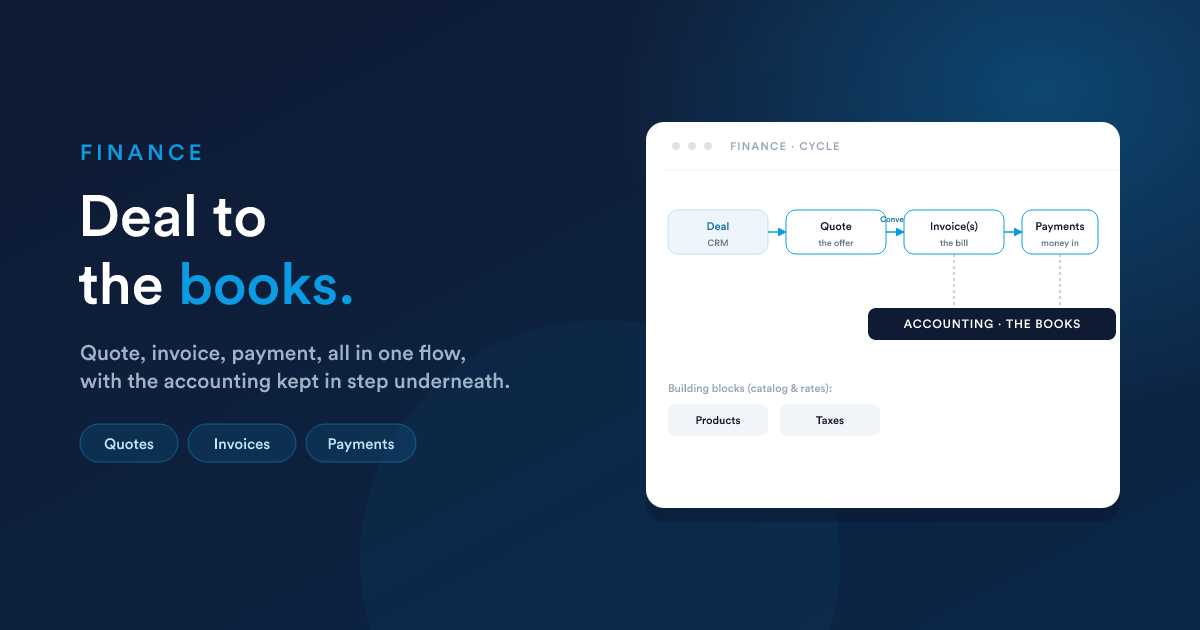
Quotes, invoices, payments, and the bookkeeping underneath them. One connected flow that starts with the deal you're closing and ends in your chart of accounts, with no separate accounting tool to keep in sync by hand.
How the pieces fit together
The deal is upstream, it lives in CRM, where a salesperson tracks the conversation that leads to a price offer. The quote is the offer itself, still pre-financial, it doesn't touch the books. Invoices and payments are the financial steps; only those two post to the chart of accounts.
Products and taxes sit alongside the cycle as the catalog and the rates that feed the lines on a quote or invoice. They're not steps in the flow, they're what the steps draw from.
What's in this section
The cycle
- Quotes: building a quote from line items, the status flow (draft → sent → invoiced), discounts at line or quote level, currency, expiration dates, and the PDF you send to the customer.
- Convert to Cash: the smart bridge from quote to invoice. Three ways to invoice (full, percentage, fixed amount), down-payment handling, multiple invoices per quote, and the 100% rule so Flexie never lets you invoice more than the quote is worth.
- Invoices: invoices on their own and invoices from a quote. The status flow (draft → finalised) and payment state (not paid → partially paid → fully paid). Invoice numbering, due dates, credit memos for returns and refunds.
- Payments: recording partial or full payments against an invoice. Methods (bank, card, cash), references, voiding a payment, and how the invoice's payment state updates as money comes in.
- Accounting: the chart of accounts, the double-entry bookkeeping that runs under every invoice and payment, the journal and ledger views, and how to map products and taxes to specific accounts.
The building blocks (what lines on a quote or invoice draw from)
- Products: what you sell. Physical products with stock tracking, or services priced by the hour, day, or job. How to set up a product's price, unit, tax, and the accounts its revenue should land in.
- Taxes: defining tax rates once and applying them across products and lines. Tax-inclusive vs. tax-exclusive pricing, sales tax vs. purchase tax, tax classes for export and domestic sales.
Two things to know up front
Quotes don't post to the books
A quote is just an offer. Until it becomes an invoice, nothing lands in your chart of accounts. This is by design: customers haggle, quotes get revised, some never close. Your books shouldn't reflect revenue until an invoice exists.
One quote can become many invoices
The convert-to-cash flow is built around the reality that a single sale often gets billed in stages, deposit now, balance on delivery or 25% on signing, 25% each quarter. You can keep coming back to the same quote and invoice the next slice, and Flexie keeps the running total straight.
When everything's been billed (whether in one invoice or six), the quote's status becomes Invoiced.
What this section deliberately doesn't cover
- Subscriptions: the recurring-billing feature isn't covered here yet. We'll add it once it's complete.
- Banking and reconciliation: bank-feed import and matching payments against bank statements live in a separate section.
- Tax filing and returns: the data needed for tax returns is in your books, but generating jurisdiction-specific tax-return forms isn't part of Flexie's Finance area today.
Closely related
- Workflow automation: automate invoice reminders, payment thank-yous, status changes.
- Reports: sales reports, AR aging, revenue by category, top customers.
- Inbox: send invoices and quotes as PDFs over email, SMS, or WhatsApp.